Made-to-measure shallow wardrobes in Benahavís
A hallway, a landing or the wall of a small bedroom often has less than 50 cm to spare, and a standard wardrobe simply won't fit. A made-to-measure shallow wardrobe in Benahavís is designed around the depth you actually have, not the one in a catalogue: we measure both the overall depth and the usable depth, choose a type of door that stays out of your way, and organise the interior so you can store more than seems possible in so little depth.
Shape your next wardrobe.
Try out the measurements, plan the interior layout and choose your finishes. See your idea take shape and share it with us so we can prepare your quote.
Send us your configuration with your measurements and we'll give you a guide price within 24 hours, free of charge. The measuring visit at your home comes afterwards.
Overall depth and usable depth: what changes in your wardrobe
The overall depth is the distance between the wall and the outer edge of the unit; the usable depth is what is left inside once the back panel, the sides and the thickness of the doors have been deducted. In a narrow wardrobe that difference matters a great deal, because a few centimetres less interior depth can decide whether a hanger will fit.
That is why, when designing a shallow wardrobe, it pays to start from the space available and subtract each element: the door, the back board, the skirting, the fittings. In a 40 cm shallow wardrobe, for example, the real interior may end up at around 34 or 35 cm, enough for folded jumpers, shoes and small items, though tight for conventionally hung clothes.
What you can store when the space has little depth
With limited depth, what works best is flat, everyday items: T-shirts, folded trousers, bed linen, towels, shoes, bags and small boxes. The depth of each shelf is tailored to what goes on it, so not a centimetre is wasted and nothing gets forgotten at the back.
When the space is only 30 cm deep, a wardrobe of that depth becomes a storage unit designed for shoes, books, jars and household products. What doesn't fit is long clothing on ordinary hangers, so it is worth deciding early what stays here and what goes in another piece of furniture elsewhere in the home, or in a deeper wardrobe in another room.
Shelves, shoe rack and front-mounted hooks
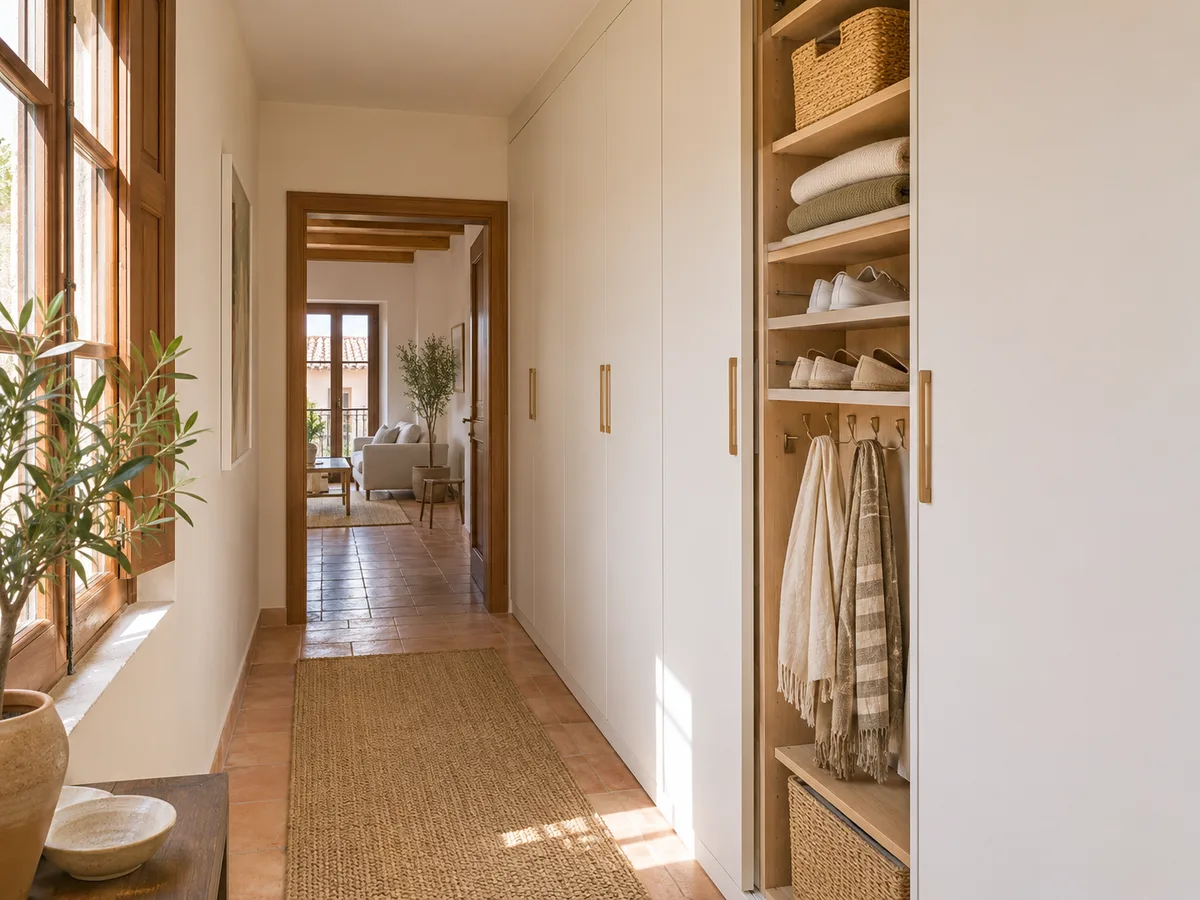
There are two solutions that are particular to narrow wardrobes. The first is the angled shoe rack, or one with tilting shelves, which holds several pairs in a depth of less than 20 cm. The second is the front-facing rail, a rotating rod on which clothes hang sideways, so each garment doesn't need the width of a standard hanger.
Height-adjustable shelves, shallow drawers on full-extension runners and internal hooks on the inside of the door also work well, adding capacity without taking depth from the body of the unit. Which combination suits you depends on what you have most of: shoes, bags, everyday clothes or accessories.
Have you already measured the space?
Send us a photo and the approximate measurements on WhatsApp and we'll give you some initial guidance.
Doors that respect walkways and nearby furniture
- 01
In a shallow space, the door is a spatial decision. A hinged door sweeps a quarter-circle in a hallway that may already be narrow, and it can block the way when it opens. Sliding doors don't swing out, but they reduce the usable depth by a few centimetres because they need their own track.
- 02
There is a third option: the bifold door, or a narrow hinged door, which opens with a minimal radius. To choose, we measure how much room there is in front and which pieces of furniture are nearby. In a hallway in a home in Benahavís where a bedroom door sits a metre away, a narrow 35 cm door may be the only one that works without getting in the way.
How we deal with skirting boards, pillars and uneven walls
Shallow spaces tend to be in areas with obstacles: a tall skirting board, a pillar, a duct, or a wall that wanders from one end to the other. Each one takes away usable depth and is measured before anything is drawn.
The skirting board is dealt with by a cut-out plinth or by setting the unit a few millimetres off the wall. A pillar or duct is integrated with a narrower module beside it or a column that wraps around it. When the wall isn't plumb, it is corrected with fillers and finishing trims, so the front stays straight even if the wall doesn't. It is detailed work, but in a narrow wardrobe every millimetre counts.
Latest work by SI, ARMARIO
@si.armario
Made-to-measure wardrobes and walk-in wardrobes
Latest posts
Where a shallow wardrobe tends to make sense
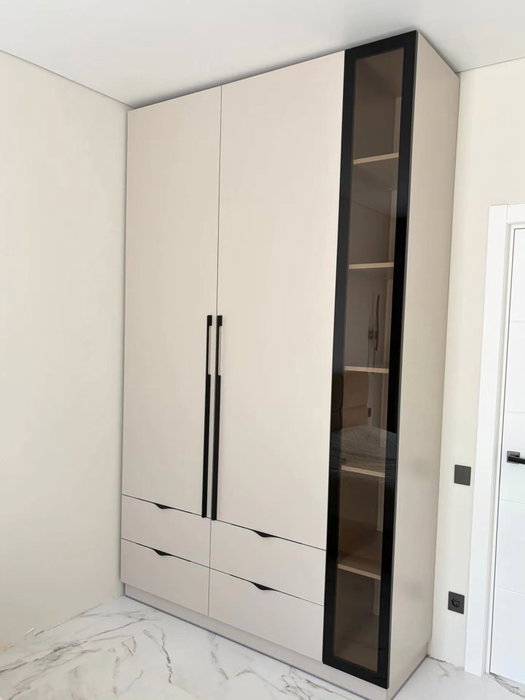
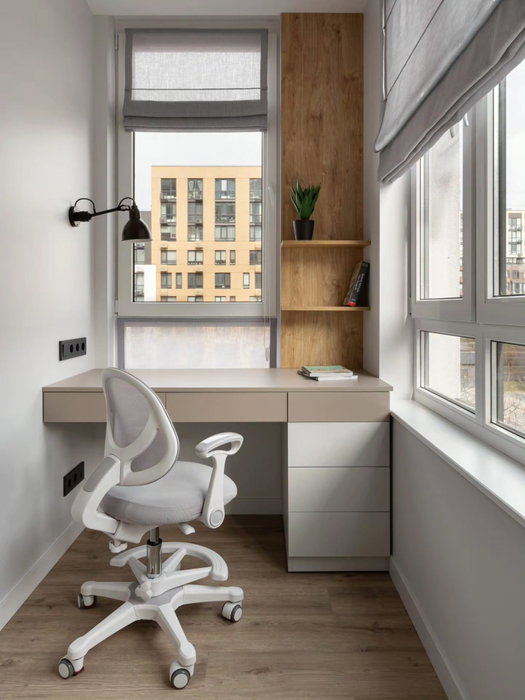
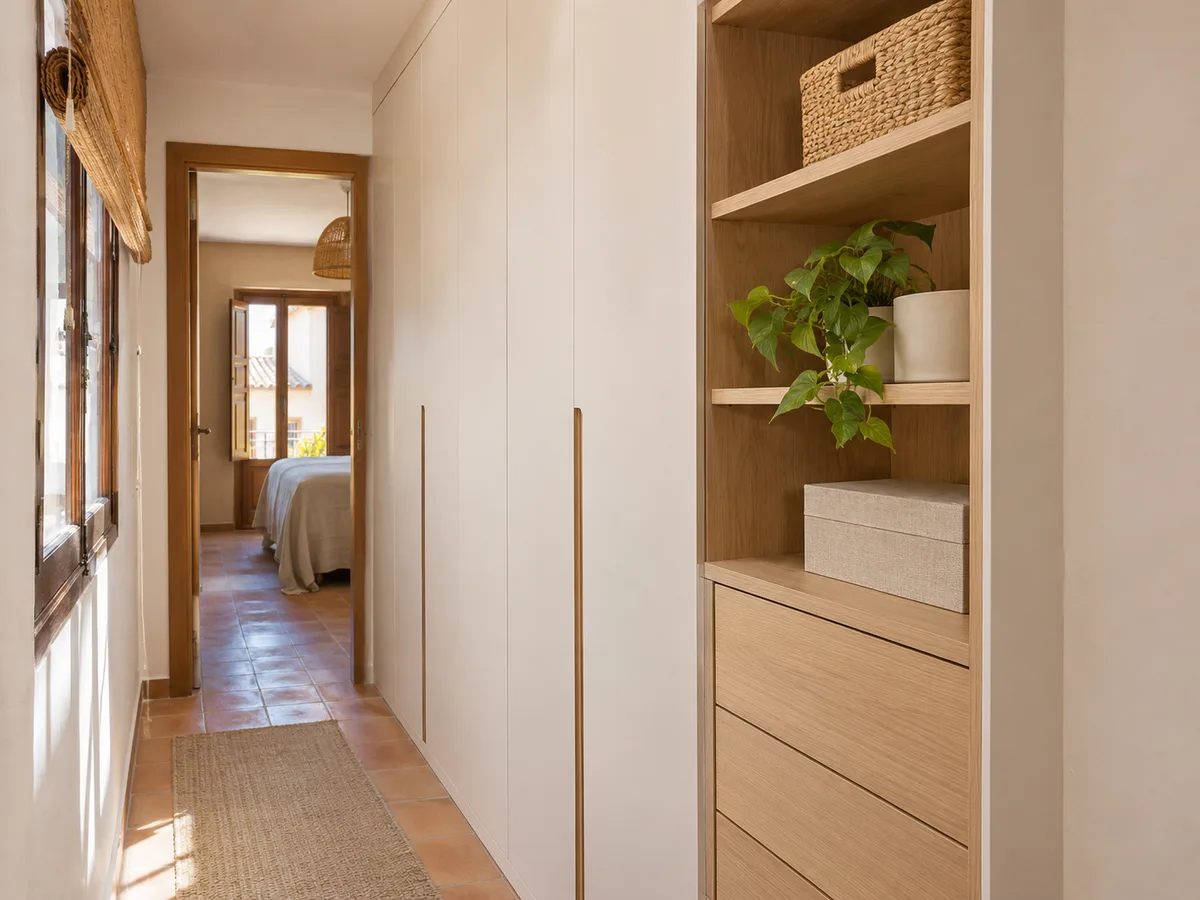
These units solve long hallways, entrance halls with nowhere for coats, stair landings, utility rooms and the free wall of a child's bedroom. They are places that stay empty because no off-the-shelf wardrobe fits, and that often add up to several metres of usable frontage.
In a home in Benahavís with a wide landing between bedrooms, a 35 or 40 cm deep run along a wall can take the whole family's shoes, the seasonal coats and the ironing equipment. The key is to check that the clear passage left is still comfortable for two people passing, and that the unit doesn't cover any switch, radiator or air outlet you need to use.
Ask us to measure up in Benahavís
- 01You leave us your name and your area.
- 02We message you on WhatsApp to agree a day.
- 03The measuring visit costs €50 and is free if you place an order.
What measurements and photos to send so we can study the space
To draw up the wardrobe you need the width at three different heights, the height to the ceiling, and the depth measured at the bottom, the middle and the top, because walls are almost never parallel. If there are skirting boards, switches, radiators or frames, note them down with their distance from the floor and from the corner.
Photos help: one of the whole wall, another of where the unit will go and a close-up of any obstacle. With those you can prepare your proposal in the configurator and the team will review it before the visit. The figures don't need to be exact; they are confirmed afterwards by whoever measures up in your home.
Finishes, quote and final check in Benahavís
- 01
In a narrow space, light finishes help the wardrobe look less bulky, and plain fronts with no visible handle avoid snagging as you walk past. Mirrored doors in a hallway double the sense of width, while a colour matching the wall makes the unit almost disappear.
- 02
As for cost, the team sends an indicative estimate within 24 hours of receiving your configuration with the measurements, at no charge. The measuring visit costs €50 and is free if you order the wardrobe. Manufacturing takes around 2–3 weeks on average, with installation arranged separately; you will find the general criteria under prices.
Enquiry
Tell us about your project in Benahavís
- 1We read your message and look at your photos.
- 2We reply on WhatsApp with a first figure.
- 3We measure up and prepare the final quote. The measuring visit costs €50 if you don't go ahead with the order and is free if you do.
We don't cut a single board until you've approved the design and the price.
Questions
Frequently asked questions about wardrobes in Benahavís
After installation: warranty and care for your wardrobe.
Is it worth fitting a unit in a space only 40 cm deep?
Yes. With a depth of 40 cm you get a usable interior of around 34 or 35 cm, suitable for folded clothes, shoes and small items. For hanging clothes, we use front-facing rails or a deeper section in another module.
Can I hang shirts and jackets in such a narrow unit?
Yes, with some caveats. A standard hanger needs about 50 cm of depth. With less, garments hang sideways on a rotating rail, or a section of the wardrobe is given a little more depth, with the rest of the interior devoted to folded items.
Are sliding doors always the best choice here?
Not always. They avoid opening out into the hallway, but they take a few centimetres off the usable depth because of the track. In a shallow wardrobe, a narrow hinged door or a bifold front sometimes works out better.
How can I use a hallway wall without making it feel cramped?
Yes, if you work out the clear passage you want to keep, which is usually about the width of a person carrying something. The depth of the wardrobe is set to that figure and the door is chosen so it doesn't intrude.
Is a shallow wardrobe only good for shoes?
No. With the right interior layout it holds folded clothes, bed linen, bags, books or cleaning products. A shoe rack is one of the most common uses, but not the only one.
Shall we talk about your project?
Send us a photo of the space and some approximate measurements on WhatsApp: we'll give you some initial guidance and arrange the measuring visit.